
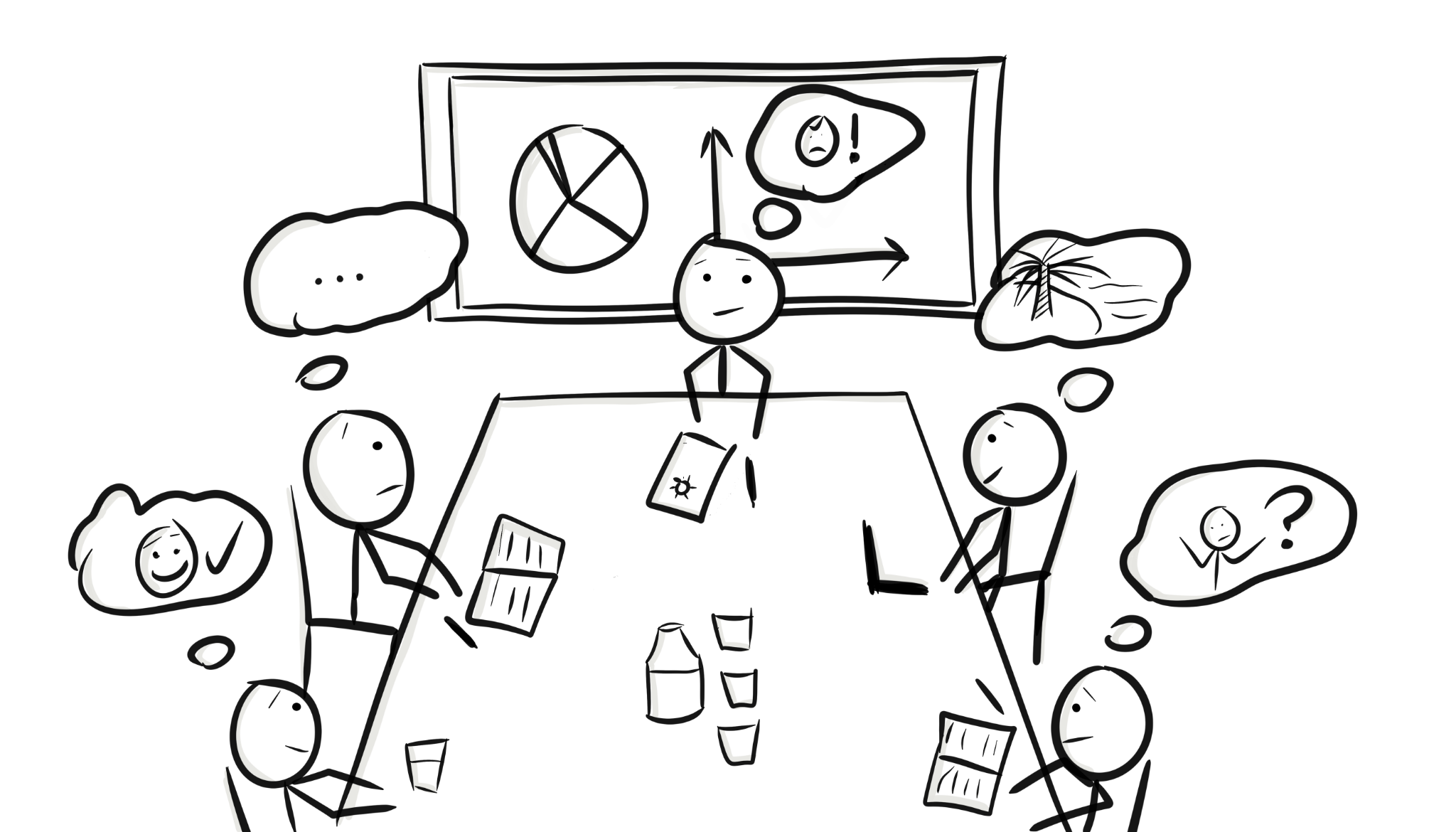
Your culture isn’t defined by your mission statement. It’s defined by the Tuesday morning WIP.
Most of the organisations we work with have a values statement, a culture programme, and a genuine intent to build somewhere people do their best work. Far fewer have looked closely at a ubiquitous facet of working life their people actually experience every day – meetings.
For the organisations that actively focus on enabling more effective meetings, we’ve seen significant improvements in engagement, innovation, decision making and efficiency. And the shift to AI-enabled work is about to make it much more consequential.
What the Data Says
Atlassian’s State of Teams research surveyed ~5,000 executives globally, 93% believe their teams could achieve the same results in half the time with better collaboration. And 51% of workers say they work overtime at least a few days a week because meetings during the day prevented them from doing the actual job. At director level and above, that rises to 67%.
Read that last one again. The more senior you become, the less of your day belongs to you.
We tend to make light of all this. There’s a guilty pleasure in complaining about the calendar with colleagues. But in the work we do with leadership teams, meetings come up constantly — not as a scheduling gripe, but as the thing quietly draining energy, slowing decisions and eroding trust. People rarely name it as a culture problem. It almost always is one.
Why This Matters More Now
Over the next few years, AI will absorb a large share of what currently fills the calendar. Status updates. Progress reporting. Information transfer. Chasing who did what by when. Microsoft’s own guidance to leaders is direct on this: use AI to strip out “status meetings, routine reports, admin churn” and reclaim the time for deep work and faster decisions.
If a meeting exists so people can tell each other things a dashboard could tell them, its days are numbered.
What remains is the harder, more human work. Judgment under ambiguity. Negotiating trade-offs. Deciding what actually matters. Building the trust that lets people disagree well. That work happens between people, and mostly it happens in meetings.
So the calculus has changed. Meetings used to be overhead we tolerated. They are becoming the primary arena where leadership gets done — and the main place an organisation either builds or burns its capacity to think.
There’s a warning inside the Microsoft research worth paying attention to. Their framing is that we risk “using AI to accelerate a broken system.” Automating around bad meetings doesn’t give you a better organisation. It gives you a faster version of the one you’ve got.
Why Meetings Are Such a High-Leverage Place to Start
They’re constant, so change compounds. Meetings happen across every team and function, every day. Small shifts in how you work spread through the organisation at a pace no leadership programme can match.
The investment is already made. You’re paying for this time regardless. Improving how you use it is the fastest return available.
Decision quality lives here. Most consequential decisions get made — or quietly avoided — in meetings. The quality of what surfaces in the room sets a ceiling on the quality of what you decide.
Information moves through them. Atlassian found 72% of workers say the only way to get the information they need is to ask someone or book a meeting. If your meetings are broken, so is how information moves through your organisation.
What Good Actually Looks Like
Effective meetings don’t happen by accident. They take intention and shared agreement about how the team operates.
- Psychological safety comes first. People need to be able to raise a risk, challenge a plan or admit a mistake without paying for it. Google’s Project Aristotle studied 180 of its own teams and found psychological safety was the strongest predictor of team effectiveness — ahead of talent mix, individual capability and role clarity. Without it, you get compliance dressed up as consensus, and you find out about problems far too late.
- Facilitation that gets the best thinking into the room. The loudest voice, or the HIPPO — the highest paid person’s opinion — shouldn’t monopolise the airtime. Not for fairness reasons. For accuracy reasons. If seniority determines whose analysis gets heard, you are filtering out information before you decide.
- Intentional structure. Clear purpose, shared agendas, and varied ways to participate — chat, visual boards, small-group discussion. People think at different speeds and in different modes. Design for that and you get more of the outcomes you’re looking for.
- Follow-through and reflection. Meetings should end with clarity about who is doing what, by when. And teams should periodically look at how they meet, not only what they meet about.
Culture Is the Sum of Repeated Behaviours
Every meeting is a chance to reinforce what an organisation says it values — respect, accountability, shared ownership. Over time these small behaviours accumulate into a culture. Not because of a campaign or an initiative, but because it’s simply how people operate.
Teams that meet well tend to make better decisions, because wider input surfaces risk earlier. Higher engagement, because people who are heard stay invested. Faster adaptation, because information moves up and sideways instead of getting stuck. And more resilience, because trust holds under pressure in a way that politeness doesn’t.
Where to Start
Start small, but be deliberate:
- Open every meeting with a clear purpose. Why are we here? If nobody can answer, cancel it.
- Protect the peak. If half your meetings sit in your team’s best thinking hours, move some of them. Block 9–11am for deep work and see what changes.
- Set default meeting lengths to 25 and 50 minutes. Transition time is real. Perpetual lateness is usually a system problem, not a discipline problem.
- Share agendas and context in advance, so people can think before they arrive rather than in the ten minutes beforehand.
- Rotate facilitators, use rounds, vary the format, so you’re not only hearing from the fastest talkers.
- Build in reflection. “How effective was that? What would we do differently next time?”
- Rotate note-taking and admin, including senior people. Who does the invisible work is one of the loudest signals in the room.
- Try ‘no meeting Mondays’ — or whichever day suits — to protect space for deep work.
- Agree an after-hours norm before the infinite workday sets one for you.
What’s Next?
Three questions for you and your leadership team:
If we removed every meeting whose purpose could be served by a written update, what would be left? And is what’s left the work we most need our people doing together?
When did we last look at the calendar as a cultural driver rather than a logistical one? What does it say about who has autonomy, whose time is protected, and what we actually prioritise?
Is it safe in our meetings to say “I don’t know”? Be specific. When did someone senior last do it, and what happened next?
Change your meetings and you change your culture. The invitation is to start tomorrow. Cancel the agenda-less catch-up. Send reflection questions in advance. Or be the first person in a room full of experts to say “I’m not sure.”
These aren’t calendar tweaks. They’re the building blocks of an organisation that can think.
If you’d like to explore this with your team, we’d love to hear from you at hello@leadersforgood.org.
Sources: Microsoft WorkLab, Breaking Down the Infinite Workday, Work Trend Index Special Report, June 2025 — based on aggregated Microsoft 365 telemetry to February 2025 and a survey of 31,000 knowledge workers across 31 markets. Atlassian, State of Teams 2025 — survey of 5,000 executives globally. Google re:Work, Understand Team Effectiveness (Project Aristotle).