In 2026, Psychological Safety isn’t about building a “nice” workplace. It’s about building a healthy, resilient one — the difference between an organisation that breaks under pressure and one that learns from it.
Pressure now arrives faster than most teams can absorb it — new technology, shifting markets, changing customer expectations. The organisations that handle this volume of change well aren’t the ones with the best plan. They’re the ones where someone shares a great new idea or says ‘hang on, that’s not right’ before a bad call gets expensive.
Every organisation we work with has access to roughly the same technology. When the tools are identical, the advantage has to come from somewhere else: the quality of the questions people ask, whether anyone flags the problem early, whether anyone’s listening when they do.
Which is why psychological safety has stopped being simply a wellbeing initiative and become the foundation of sustainable high performance and your competitive advantage.
As a people and culture professional: your role has never mattered more. The thing that differentiates businesses in this AI world actually sits squarely in your remit.
Why Aren’t More Leaders Acting on Psychological Safety?
Not because they disagree. In our experience, almost nobody argues against psychological safety. They just don’t do anything about it, for three fairly practical reasons.
- It’s badly understood. Leaders routinely confuse psychological safety with being nice. They hear it and picture a workplace where nobody’s held to account and hard conversations are avoided. It’s almost the reverse — high psychological safety is what makes a potentially hard conversation accepted and valued. It raises the standard, precisely because people can name problems without it costing them.
If you want the 90-second version: watch our short explainer video.
- It doesn’t pay you back this quarter. Psychological safety compounds. It’s the opposite of a quick win, and it competes for attention against things that show a more immediate return on investment.
- It’s not measured. No baseline, no link to performance, no number to put in front of a CFO. And what doesn’t get measured doesn’t get funded.
Add cultures that are hierarchical, siloed, or under sustained pressure, and the odds that Psychological Safety is prioritised get worse. Speaking up in those environments isn’t just uncomfortable — it’s professionally and rationally risky.
The ROI Of Psychological Safety
The measurement problem is the solvable one, so let’s start there.
We recently worked with a sales organisation to map psychological safety team by team, then overlaid two things: performance against target, and team health — turnover, absenteeism, engagement participation, engagement scores.
The teams with the highest psychological safety delivered ~50% more against sales targets and scored ~60% better on team health.
Once you can see that, you can model it. If lifting two underperforming teams to the level of your best moves sales delivery and cuts turnover, that’s not just a wellbeing argument anymore. It’s tangible financial incentive.
We observed a similar pattern in a marketing business we worked with. Most of their teams were in decent shape; several weren’t, and those teams correlated tightly with low engagement.
On employee turnover alone, they saved roughly $250,000 a year in avoided recruitment, hiring, and training costs.
Customer relationships, the thing their business actually runs on, were measurably weaker in those teams too.
The pattern shows up on both sides of the ledger — less turnover and absenteeism, but also faster decisions and fewer blind spots, because problems surface while they’re still cheap to fix.
Where to Intervene
It helps to think about psychological safety in stages rather than as a single dial. People need to feel they belong before they’ll risk learning in public. They need to feel safe learning before they’ll contribute ideas. And contributing ideas is a long way short of challenging the status quo — which is the level that catches the expensive mistakes, and the level few organisations consistently reach.
The aviation industry learned this the hard way. There’s a grim catalogue of preventable crashes where the co-pilot saw the problem and didn’t push hard enough against a more senior captain. If challenge is that hard at 30,000 feet with lives on the line, be realistic about how hard it is in your weekly leadership meeting.
Which brings us to the point most psychological safety work misses. Behaviour is one lever, and it’s the one everyone reaches for first, usually a training session, sometimes a good one. But behaviour sits inside a system, and the system usually wins.
Reporting lines that nobody understands means nobody knows who to raise a concern with. Incentives that reward certainty teach people to hide doubt. Meetings run so the most senior voice goes first will produce agreement every time, and you’ll mistake it for alignment.
We often have very senior leaders asking us why nobody challenges them. One CEO told us they always ask their people for it — but that didn’t play out in reality. Challenge appeared nowhere in the organisation’s values, nowhere in how meetings ran, and nowhere in what got rewarded. They changed the values to include ‘challenge is part of the job’, redesigned how meetings were run, and put engagement metrics into leadership KPIs.
Three Things Worth Doing Now
- Understand where you actually are. You almost certainly have relevant data already — engagement results, turnover, exit interviews. Map it against the stages above and you’ll quickly build a picture of your current level of Psychological Safety.
- Get your executive team aligned. Not a briefing on why psychological safety is nice. A conversation about what it’s costing you right now, in the numbers they already care about.
- Build the baseline behaviours. There’s a range of observable behaviours that build or erode safety in every team. They’re not complicated. They just have to happen consistently, which is the hard part.
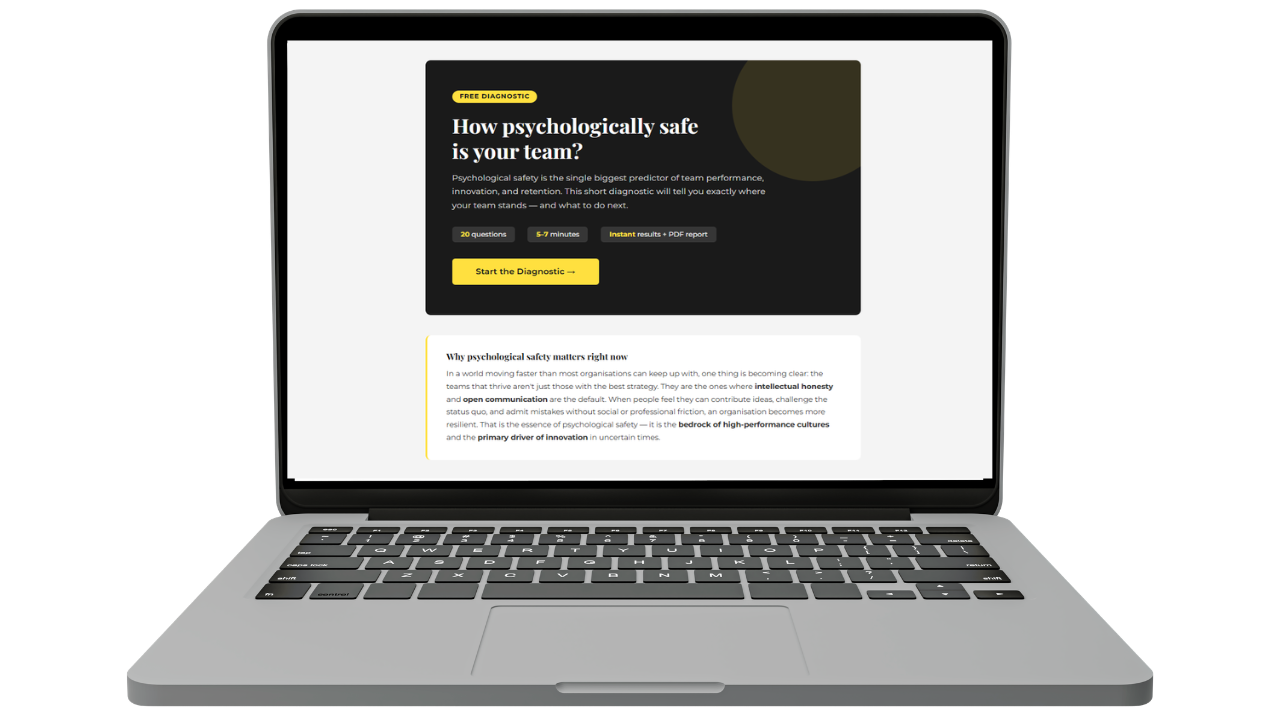
We’ve built a short diagnostic — 20 questions, focused on observable behaviours rather than feelings — that gives a team a clear read on where they sit and what to do about it. It’s free, and you can run it yourself.